
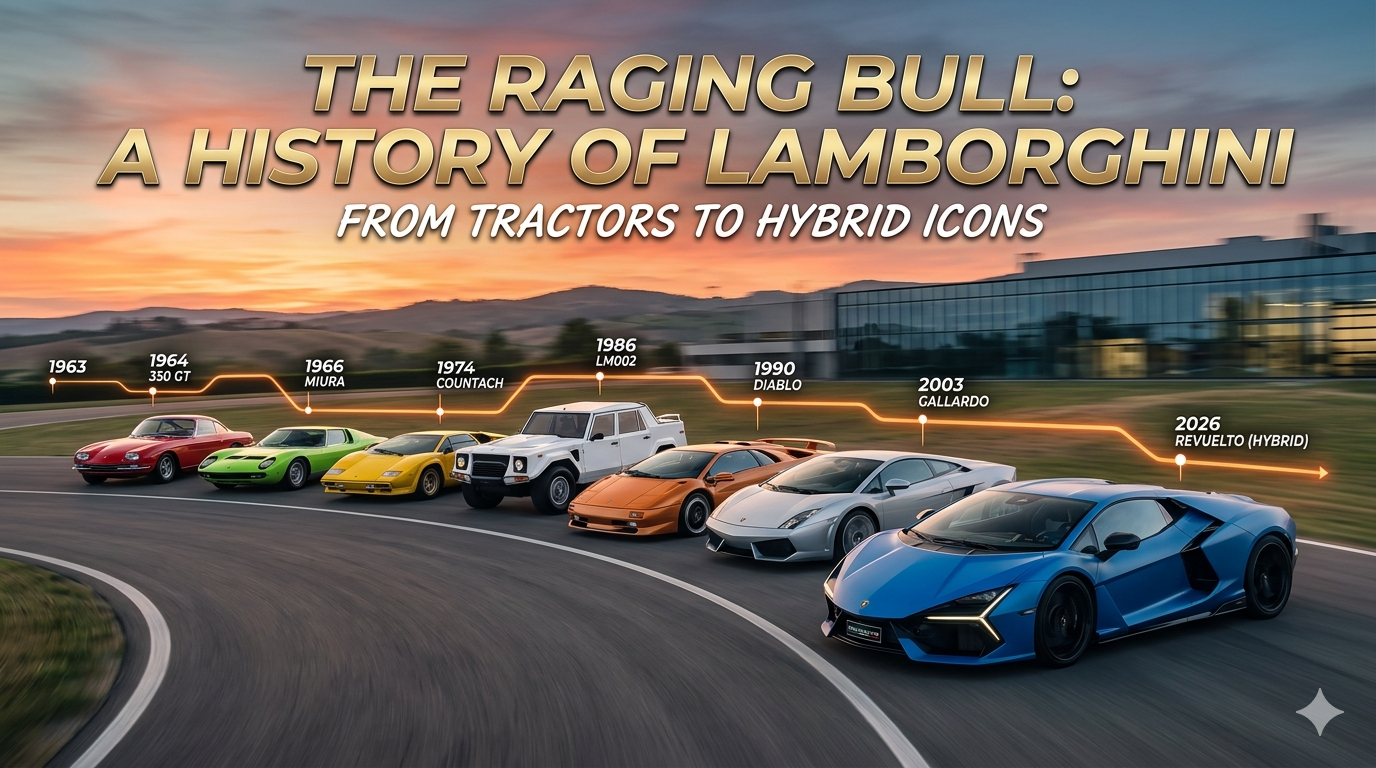
The story of Lamborghini is one of the most celebrated legends in automotive history. It is a tale that begins not with a race car, but with a tractor; not with a professional rivalry, but with a personal insult. Over the last six decades, Lamborghini has evolved from a small boutique manufacturer into a global icon of uncompromising performance, “poster-car” design, and Italian craftsmanship.
I. The Genesis: From Agriculture to Aristocracy (1916–1963)
Ferruccio Lamborghini was born in 1916 under the zodiac sign of Taurus—a fact that would later define the visual identity of his empire. A gifted mechanic, Ferruccio served in the Italian Royal Air Force’s transport section during World War II. After the war, he saw a desperate need for agricultural machinery in a rebuilding Italy. Using surplus military hardware, he founded Lamborghini Trattori in 1948.
By the early 1960s, Ferruccio was a wealthy industrialist. He owned several Ferraris, but he was perpetually frustrated by their mechanical temperaments, particularly their clutches.
The Famous Insult
Legend says that Ferruccio took his complaints directly to Enzo Ferrari. Enzo, famously prickly, reportedly told him, “The problem is not with the car, but with the driver who handles it. Go back to your tractors.”
Infuriated, Ferruccio decided to build a “perfect” grand tourer to prove that he could beat Ferrari at his own game. In 1963, Automobili Lamborghini was established in Sant’Agata Bolognese.
II. The V12 Foundations (1963–1970)
Ferruccio’s goal was a refined, high-speed car that lacked the “raw” compromises of racing-derived Ferraris.
- The 350 GTV & 350 GT: The first prototype, the 350 GTV, debuted in 1963. It was followed by the production 350 GT in 1964, featuring a 3.5-liter V12 designed by Giotto Bizzarrini. It was sophisticated, comfortable, and fast.
- The Miura (1966): This car changed everything. While Ferruccio wanted grand tourers, his engineers (Stanzani and Dallara) secretly worked on a mid-engine chassis. When the Miura debuted, it essentially invented the term “Supercar.” Its transverse V12 and breathtaking bodywork by Bertone made it an instant icon.
III. The Wedge Era and Financial Turmoil (1971–1987)
The 1970s were a period of creative brilliance overshadowed by economic hardship.
The Countach (1974)
If the Miura was beautiful, the Countach was alien. With its scissor doors, sharp “wedge” design by Marcello Gandini, and massive air intakes, it became the definitive poster car of the 1980s. It remained in production for 16 years, evolving from the clean LP400 to the winged 25th Anniversary edition.
Ownership Changes
Despite the Countach’s fame, the 1973 oil crisis and global recession hit Lamborghini hard. Ferruccio sold his remaining shares in 1974. The company went through several owners:
- Georges-Henri Rossetti and René Leimer (1974–1980): A period of stagnation.
- The Mimran Group (1980–1987): They revitalized the brand, introducing the Jalpa (V8) and the LM002—the world’s first true “Super SUV.”
IV. The Chrysler and Audi Eras (1987–Present)
In 1987, the American giant Chrysler purchased Lamborghini. Under their leadership, the Diablo was launched in 1990—the first Lamborghini to exceed 200 mph. However, Chrysler eventually sold the company to a Malaysian investment group, who later sold it to Audi (Volkswagen Group) in 1998.
The Audi Renaissance
The acquisition by Audi brought German engineering precision to Italian passion. This era produced:
- Murciélago (2001): The successor to the Diablo, bringing AWD and refinement.
- Gallardo (2003): The “baby Lambo” with a V10, which became the brand’s best-selling model at the time.
- Aventador (2011): A carbon-fiber masterpiece that kept the V12 fire burning for another decade.
- Urus (2018): A massive commercial success that effectively funded the brand’s future development.
V. 2026 and Beyond: The Hybrid Revolution
As of early 2026, Lamborghini is navigating a significant pivot in its “Direzione Cor Tauri” strategy. While originally eyeing a full electric future, the brand has adjusted to market realities.
Scrapping the Full EV Supercar
In a major shift confirmed in late 2025 and early 2026, CEO Stephan Winkelmann announced that Lamborghini has scrapped plans for an all-electric supercar (previously hinted at by the Lanzador concept). The reason? Customers still demand the “emotional connection” of an internal combustion engine (ICE).
The Hybrid Focus
Instead, the brand is doubling down on Plug-in Hybrids (PHEV) to keep the roar of the engine alive while meeting emission standards:
- Revuelto: The V12 hybrid flagship.
- Temerario: The new V8 twin-turbo hybrid replacing the Huracán.
- Urus SE: The hybridized version of the best-selling SUV.
Conclusion
From a tractor shed to the cutting edge of hybrid technology, Lamborghini has remained true to Ferruccio’s “warrior” spirit. While the industry pushes toward silent electrification, the Raging Bull has chosen to fight for the soul of the engine, ensuring that the sound and fury of Sant’Agata will be heard for years to come.
Summary of Iconic Models
| Decade | Iconic Model | Significance |
| 1960s | Miura | Invented the modern supercar layout. |
| 1970s/80s | Countach | Defined the “wedge” aesthetic and scissor doors. |
| 1990s | Diablo | First Lamborghini to break the 200 mph barrier. |
| 2000s | Gallardo | Massively expanded the brand’s global reach. |
| 2010s | Urus | Proved that a Super-SUV could be a top seller. |
| 2020s | Revuelto | The first “HPEV” (High Performance Electric Vehicle). |

No responses yet