
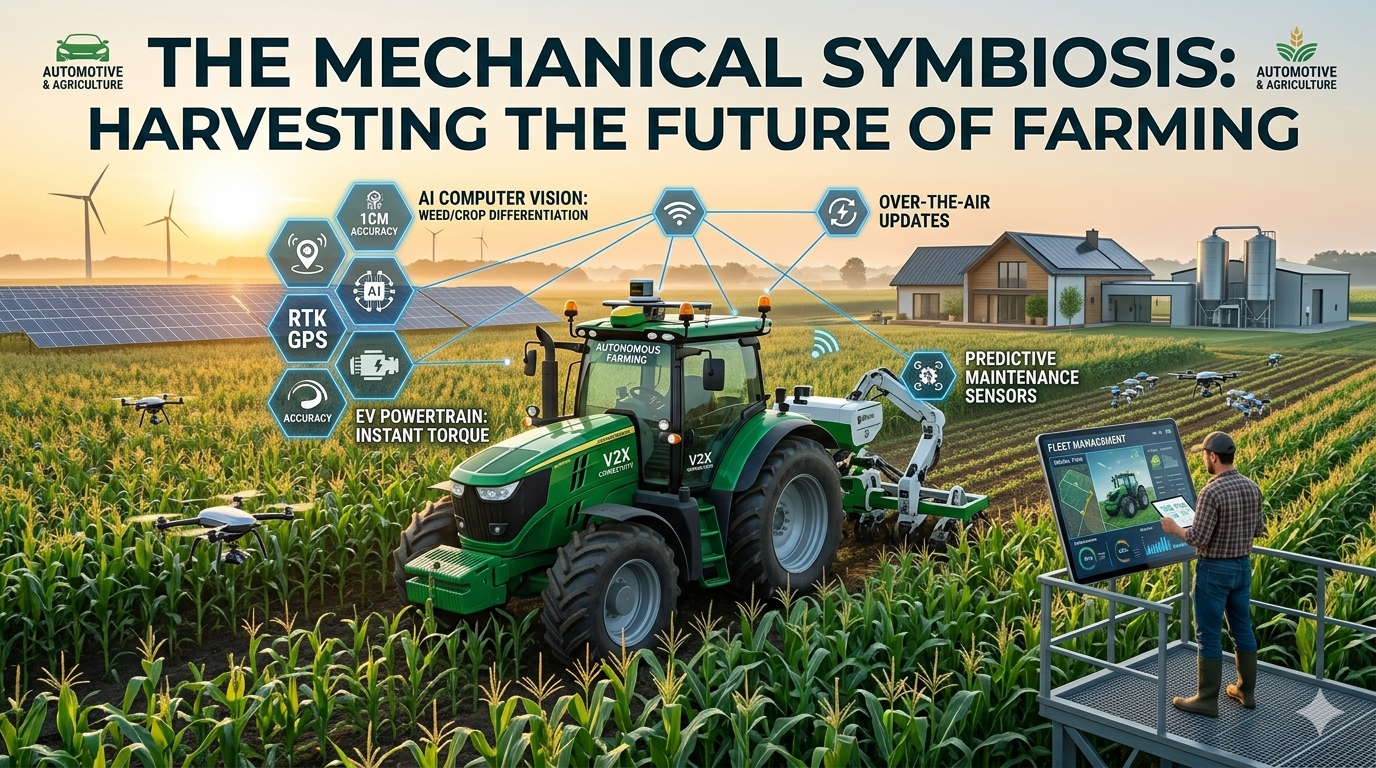
For over a century, the automotive and agricultural industries moved on parallel tracks. One was focused on the speed and luxury of the open road; the other on the rugged endurance of the open field. But as we move through 2026, those tracks have officially merged. The modern tractor is no longer just a piece of farm equipment—it is a sophisticated automotive platform, a high-tech “rolling computer” that borrows its brain from self-driving cars and its heart from the electric vehicle (EV) revolution.
This convergence is not just a matter of convenience; it is a necessity. With a global population projected to reach 10 billion by 2050 and a shrinking agricultural workforce, the “automotive-ization” of the farm is the only way to ensure food security while maintaining profitability.
I. The Brain: Autonomous Navigation and “Auto-Steer”
The most visible gift from the automotive sector to the farmer is Autonomous Driving. While Tesla, Waymo, and Cruise have spent the last decade navigating the unpredictable chaos of city intersections, agricultural giants like John Deere, Case IH, and AGCO have perfected the same technology in the controlled environment of the field.
Precision at the Centimeter Level
In a car, “lane keep assist” is a safety feature. In a tractor, it is an economic powerhouse. Using RTK (Real-Time Kinematic) GPS—which provides centimeter-level accuracy—automotive steering systems allow tractors to follow perfectly straight lines without human intervention.
- The Benefit: This eliminates “overlap” (the accidental double-spraying or double-planting of the same row). In 2026, research shows that autonomous steering reduces seed and fertilizer waste by up to 15%, which for a large-scale operation, translates to hundreds of thousands of dollars saved annually.
The “Human-in-the-Loop” Model
While fully driverless tractors are now commercially available, the current trend is “Supervised Autonomy.” A single operator can sit in a pickup truck at the edge of the field and manage a fleet of three or four autonomous tractors simultaneously via a tablet. This automotive-derived “fleet management” is a direct solution to the global shortage of skilled agricultural labor.
II. The Heart: Electrification and the End of Diesel Dominance
The internal combustion engine (ICE) has been the backbone of farming since the death of the horse-drawn plow. However, the EV Revolution is finally reaching the dirt.
Why Electric Tractors Work Better
An electric motor is fundamentally better suited for farming than a diesel engine.
- Instant Torque: Unlike diesel, which needs to “rev up” to find its power, electric motors provide maximum torque at 0 RPM. This is critical for heavy-draft tasks like deep-soil tilling.
- Simplified Maintenance: A traditional tractor has thousands of moving parts in its engine and transmission. An electric tractor has a fraction of that, meaning fewer oil changes, no fuel filters to clog, and significantly less downtime during the critical harvest season.
- The “Farm-to-Socket” Loop: Many modern farms are now energy producers, utilizing solar arrays on barn roofs or wind turbines in the fields. Farmers can now “fuel” their automotive-grade tractors for free using the sun, decoupling their food production costs from the volatile global oil market.
Hybrid “Range Extenders”
For the most grueling tasks, like 24-hour harvesting, 2026 has seen the rise of Hybrid-Electric tractors. These use a small, efficient diesel generator to charge a battery pack that drives electric motors at each wheel—a direct descendant of the hybrid tech perfected in cars like the Toyota Prius and BMW i8.
III. The Eyes: Computer Vision and “See & Spray”
Automotive Computer Vision—the technology that allows a car to “see” a pedestrian or a stop sign—has been adapted for what is known as Precision Chemical Application.
Targeted Weed Control
Traditionally, farmers practiced “broadcast spraying,” essentially coating an entire field in chemicals to kill weeds. Today, automotive-grade high-speed cameras and AI (artificial intelligence) process images of the ground as the tractor moves.
- The “See & Spray” Effect: The system can distinguish between a crop (like corn) and a weed (like ragweed) in milliseconds. It only triggers the spray nozzle when a weed is detected.
- The Result: This technology, borrowed from automotive obstacle-detection algorithms, reduces chemical usage by nearly 80%. It is better for the soil, better for the consumer, and significantly better for the farmer’s bottom line.
IV. The Nervous System: Telematics and the “Software-Defined” Farm
Modern cars are “Software-Defined Vehicles” (SDVs), meaning their performance can be improved via Over-the-Air (OTA) updates. This concept has revolutionized farm machinery management.
Predictive Maintenance
Just as your car might alert you to a low tire pressure or a failing sensor, telematics systems now connect the entire farm. If a tractor in a remote field starts to show a slight increase in bearing temperature, the system alerts the farmer’s smartphone immediately.
- The “Digital Twin”: In 2026, many manufacturers provide a “digital twin” of the tractor in the cloud. Software runs simulations of the machine’s performance, predicting when a part will fail before it actually breaks. This “proactive” rather than “reactive” maintenance is a standard automotive practice that has saved the agricultural industry billions in lost productivity.
V. Comparison: The Evolution of Farm Power
| Feature | The 20th Century Tractor | The 2026 Automotive-Hybrid Farm Vehicle |
| Power Source | High-sulfur Diesel | Battery-Electric or Diesel-Hybrid |
| Guidance | Human Sight / Markers | GPS-RTK / LiDAR / Computer Vision |
| Maintenance | Scheduled (Oil/Filters) | Predictive (AI-Based Sensors) |
| Connectivity | None | 5G / Satellite / V2X (Vehicle-to-Everything) |
| Efficiency | Low (Heavy Overlap) | High (Centimeter-level Precision) |
VI. The Future: Modular Robotics and Swarm Farming
As we look toward 2030, the “automotive-farm” connection is heading toward Swarm Farming. Instead of one massive, 20-ton tractor that compacts the soil and costs $500,000, automotive manufacturers are helping develop “swarms” of small, lightweight, autonomous robots.
These “swarms” work together like a school of fish. If one robot breaks down, the others continue. They are lighter, cheaper to produce, and utilize the same mass-manufacturing techniques used for budget electric cars.
Conclusion
The infusion of automotive technology into agriculture is more than a mechanical upgrade; it is a fundamental shift in how we interact with the land. By borrowing the “senses” (cameras/LiDAR), the “brain” (AI/GPS), and the “heart” (Electric Motors) of the automotive world, the modern farm has become a model of efficiency. In 2026, the question is no longer whether automotive tech helps in farming—it is whether farming could even survive without it.
Did You Know? The same LiDAR sensors used by luxury cars to detect obstacles in the dark are now being used on tractors to map the topography of a field in 3D, allowing for “Variable Rate Seeding” where the machine automatically plants more seeds in rich soil and fewer in sandy areas.
As these technologies become more affordable, do you think the era of the human tractor driver is officially coming to a close?

No responses yet