
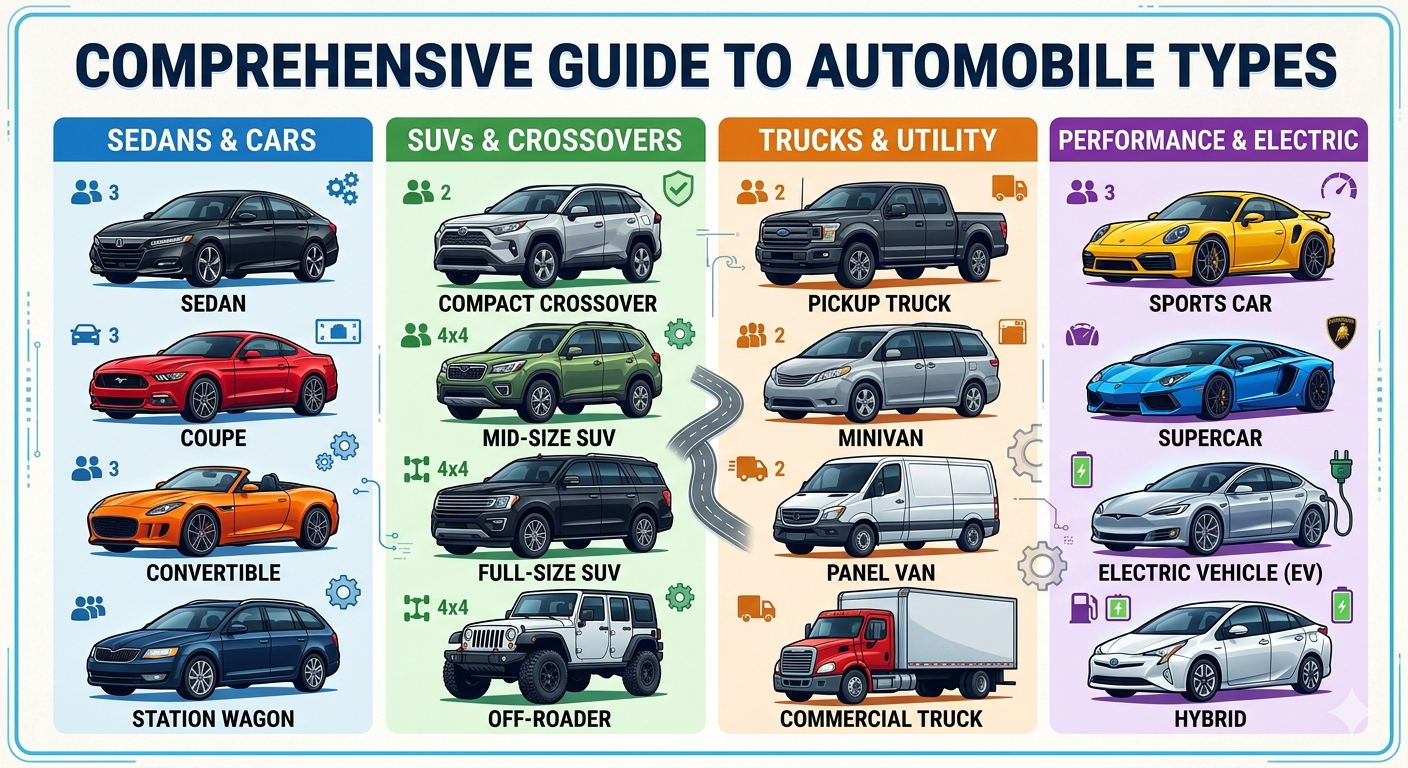
The automobile is no longer a “one-size-fits-all” machine. Since Karl Benz’s three-wheeled Patent-Motorwagen first sputtered to life in 1886, the car has undergone a radical biological-style evolution. Today, the automotive landscape is a diverse ecosystem where vehicles are specialized for speed, utility, luxury, or environmental efficiency.
To understand the modern market, one must categorize vehicles not just by how they look, but by their body style, powertrain, and intended purpose.
I. The Classics: Sedan, Coupe, and Convertible
These are the “blueprints” of the automotive world—the shapes that defined the 20th century.
1. The Sedan
The sedan remains the quintessential car. Defined by a three-box configuration (engine, passenger, and cargo), it features four doors and a traditional trunk.
- Sub-types: Compact (Honda Civic), Mid-size (Toyota Camry), and Full-size/Luxury (Mercedes-Benz S-Class).
- Appeal: Sedans offer better fuel economy and handling than SUVs due to their lower center of gravity and superior aerodynamics.
2. The Coupe
A coupe is traditionally a two-door car with a fixed roof. It is often a sleeker, more “sporty” version of a sedan. In recent years, marketers have blurred these lines with “four-door coupes,” which feature a sloping, fastback roofline on a four-door frame.
- Examples: BMW 4 Series, Ford Mustang.
3. The Convertible (Cabriolet/Roadster)
The convertible features a roof that can be retracted or removed, allowing for an open-air driving experience.
- Hard-top vs. Soft-top: Hard-tops provide better insulation and security, while soft-tops (fabric) are lighter and offer a more classic aesthetic.
- Roadster: A specific type of two-seat convertible designed for sporty performance (e.g., Mazda MX-5 Miata).
II. The Utility Kings: SUVs, Crossovers, and Pickups
This is currently the most dominant segment of the global automotive market.
1. The SUV (Sport Utility Vehicle)
True SUVs are built using body-on-frame construction (similar to trucks). This makes them rugged, capable of heavy towing, and superior for off-roading.
- Examples: Chevrolet Tahoe, Jeep Wrangler, Toyota Land Cruiser.
2. The Crossover (CUV)
The “Crossover” looks like an SUV but is built on a unibody platform (similar to a sedan). This makes them lighter, more fuel-efficient, and more comfortable for daily commuting, though less capable off-road than a true SUV.
- Examples: Toyota RAV4, Honda CR-V, Nissan Qashqai.
3. The Pickup Truck
Once strictly tools for farmers and construction workers, pickups are now lifestyle vehicles.
- Full-Size: The titans of the road, capable of immense towing (Ford F-150, Ram 1500).
- Mid-Size: More maneuverable for urban environments (Toyota Tacoma, Chevrolet Colorado).
III. Practicality Specialists: Hatchbacks, Wagons, and Minivans
These vehicles prioritize internal volume and flexibility above all else.
1. The Hatchback
A hatchback is a car with a rear door that swings upward, providing access to a cargo area that is integrated with the passenger cabin. They are popular in Europe and Asia for their “small on the outside, big on the inside” design.
- Hot Hatch: A high-performance version of a hatchback (e.g., Volkswagen Golf GTI).
2. The Station Wagon (Estate)
Essentially a sedan with an extended roofline that stretches all the way to the back. Wagons offer the cargo capacity of an SUV with the superior handling of a car. While they have lost popularity in North America, they remain a staple of European luxury (e.g., Audi A6 Avant).
3. The Minivan (MPV)
The ultimate family hauler. With three rows of seating and sliding doors, no other vehicle type manages passenger space as efficiently.
- Examples: Honda Odyssey, Chrysler Pacifica.
IV. Performance and Exotic Categories
When the goal is speed, emotion, and engineering prestige.
| Category | Primary Focus | Typical Examples |
| Sports Car | Handling and agility | Porsche 718 Cayman, Nissan Z |
| Muscle Car | Straight-line speed / V8 Power | Dodge Challenger, Ford Mustang |
| Supercar | Extreme performance / Mid-engine | Ferrari F8, Lamborghini Huracán |
| Hypercar | Cutting-edge tech / Top speed | Bugatti Chiron, Rimac Nevera |
V. The Powertrain Revolution
Modern automobiles are no longer defined solely by their shape, but by what fuels them.
1. Internal Combustion Engine (ICE)
The traditional engine powered by gasoline or diesel. While being phased out in some regions, they remain the most affordable and accessible option for many.
2. Hybrid Electric Vehicles (HEV)
These use both a gas engine and an electric motor. The battery is charged through regenerative braking and the engine itself—you never “plug it in.”
- Example: Toyota Prius.
3. Plug-in Hybrid (PHEV)
Similar to a hybrid, but with a larger battery that can be charged from a wall outlet. These can often drive 20–50 miles on electricity alone before the gas engine kicks in.
- Example: Mitsubishi Outlander PHEV.
4. Battery Electric Vehicles (BEV)
Purely electric. They have no tailpipe, no engine, and run entirely on battery power.
- Example: Tesla Model 3, Hyundai Ioniq 5.
5. Hydrogen Fuel Cell (FCEV)
These vehicles use hydrogen gas to generate electricity on board. The only emission is pure water vapor.
- Example: Toyota Mirai.
VI. Specialized and Commercial Vehicles
Beyond personal transport, automobiles serve specific societal functions:
- Microcars: Ultra-compact vehicles for dense urban environments (e.g., Smart Fortwo).
- Limousines: Extended-wheelbase luxury vehicles for chauffeured transport.
- Off-Roaders: Specialized machines with high ground clearance and 4WD (e.g., Ford Bronco).
The “best” type of automobile is entirely subjective, depending on a driver’s specific needs. Whether it’s the rugged dependability of a pickup, the silent efficiency of an EV, or the emotional roar of a supercar, the diversity of the automotive world ensures there is a machine for every person and every purpose. As technology continues to evolve, the lines between these categories will likely continue to blur, leading to even more innovative ways to move from point A to point B.

One response
Hi, this is a comment.
To get started with moderating, editing, and deleting comments, please visit the Comments screen in the dashboard.
Commenter avatars come from Gravatar.